
Archive for the ‘France, 2009’ Category.

We’ve been back from France for two weeks now and Autumn is definitely with us. I’ve finally finished sorting and processing our photographs which naturally jog the memories and prompt a little backward reflection.

The weather was great. I’m even more convinced now that the main ingredient required for a good time is good weather. Given our enjoyment of walking, cycling and generally living outside, without it we’d be pretty much screwed. During our six weeks trip we had just two mornings that were wet and two overnight downpours. The rest of the time was dry and, for the most part, very sunny with my good ol’ favourite clear blue skies.
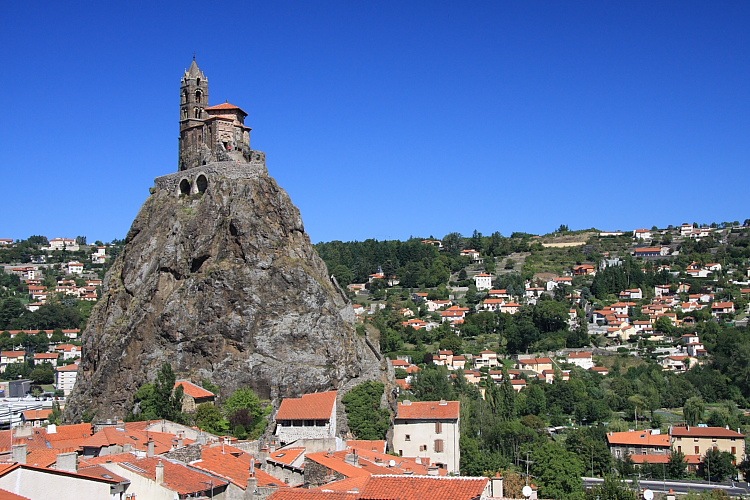
Le Puy-en-Velay: home of lava, lentils and lace. The other advantage that settled weather brings is the ability to travel to different places with impunity. We’d been wanting to head east towards pastures new in the French Alps for a couple of years but, if there’s any bad weather about, mountains tend to attract it. No problems this year, the east was clear. We started off down the centre of France at a tried and trusted spot before striking out southeast to pastures new. Le Puy-en-Velay and Die were fun but our original target, Barcelonnette in the Mercantour, didn’t appeal and we left immediately heading towards Digne-les-Bains in Provence. Much better. Then we tacked back west through Les Alpilles heading for Carol’s birthday lunch at Marseillan harbour where we were surprised and delighted to be joined by our friends Steve and Rosemary, along with their new tent, to help us celebrate. Excellent! They were in France anyway but it was a long way down to the south for them. Thank you both.
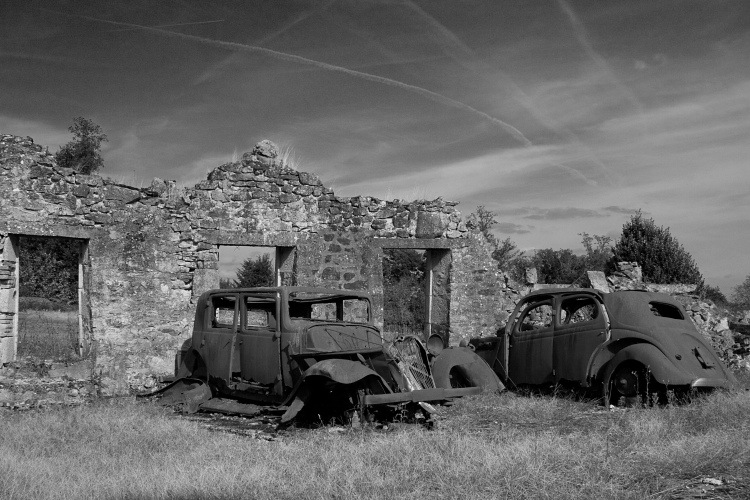
Rusting wartime cars in Oradour-sur-Glane One of my strongest memories will be the martyr village of Oradour-sur-Glane on the way back north (near Limoges). It was the site of a dreadful Nazi massacre in 1944, our second such site on this trip after the Vercors Massif. The ruins of the original village of Oradour-sur-Glane have been preserved magnificently just as the Germans left them. It’s an extraordinarily emotive place that brings tears to my eyes every time I look back at the photographs. If you get the chance, visit it.

Sombre wartime memories aside, we had a wonderful time and are missing the Indian summer weather. I was intrigued to find that even the French referred to it as l’été Indien.
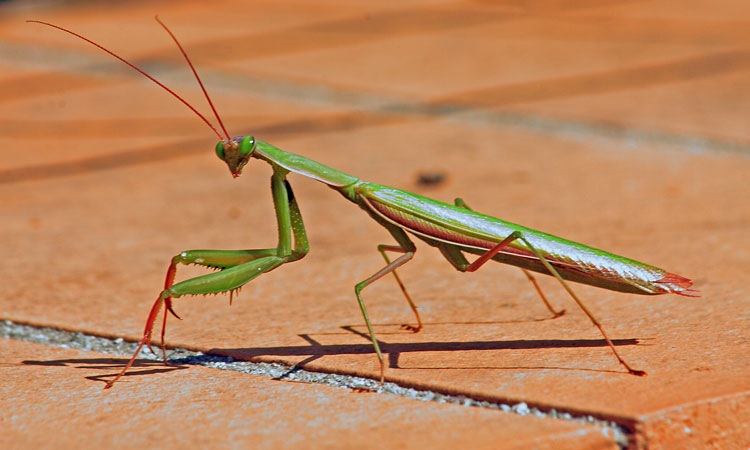
Praying Mantis watching me It was our longest trip yet covering 3,200 miles and we pressed our cameras’ shutters about 1400 times between us. About 400 of mine must have been aimed at insects, mostly dragonflies and damselflies. Still, it’s good to have an interest. ;) As in the days of film, we’ve discarded over 50%. What I hope is a representative, not-too-large selection (60) of the remaining shots is now published here:

http://www.curdhome.co.uk/photos/2009_France/index.htm

We are going to have to find some way of brightening up the coming winter.

This is by way of another retrospective post from our sadly now complete recent tour around La Belle France. I’m still engaged in processing our digital images trying to select those that I think will make a representative web album of our trip and I’ve come across a shot that I perhaps don’t want to include but which I think shouldn’t go unpublished.

Nature is one of our shared interests and takes up quite a bit of our time on these trips. Some places appeal to us simply because they are rich in wildlife. One such place is Camping Les Brugues, a dairy sheep farm just outside Fanjeaux. The fact that it is also one of France’s finest campsites doesn’t hurt. The site borders a small lake which seems to be teaming with wildlife including birds, dragonflies, coypus and frogs; thousands of frogs. We met one couple a few years ago who shut all their windows and vents because the nightly chorus of frogs kept them awake. [Ed: Sad; I lie awake enthralled listening to it.]

Eating frogs legs We are all familiar with the French eating grenouille. We’ve even given them a less than complimentary nickname because of it. Here, though, is photographic evidence the Frogs do, indeed, eat frogs’ legs. Well, at least, they try. I can’t help but think that this one tried to bite off more than it could chew, though. Normally, the frog’s legs would be separated from the hapless frog before anyone attempted to consume them. Not in this case.

Still eating frogs legsI knew that tadpoles were cannibalistic and would greedily devour each other but I thought frogs were supposed to catch flies rather than each other. This particular green cannibal was so tenacious that, when I snapped a little too close and scared it, it jumped into the lake and still did not let go.

We’re not sure of the outcome but Carol thinks she saw a less-than-happy looking frog on its back which subsequently disappeared. There was clearly no way this frog was going to swallow something half its size and survive so we suspect that contact was eventually broken.

Gruesome, though, isn’t it?

I think so, not that I’m a great expert on Roman Numerals.

Foreground cross, background chateau of Roquefixade.At home processing our collection of photographs, this is something of an addendum to our recently completed trip around France. One of the places Carol and I visited was Roquefixade. The village nestles beneath a so-called Cathar castle built on a precarious-looking precipice overlooking the village. On our way up to the castle ruins we passed a stone cross which I snapped as some foreground interest when taking a distance shot of the castle for context. I took little more notice of the cross at that time.

Confusing cross When we were returning from our climb we passed by the cross again and, just because I was wasting only reusable pixels, I snapped the cross again. Apart from some fancy scroll work, it bore a date in Roman numerals. I looked harder – something didn’t ring true. The engraving clearly reads:

MCMDXXXVI

That can’t be right, can it? “MCM” is Roman for 1900 which, given the dates around here, seems odd enough but to follow that with “D” for 500 makes no sense, surely. I decided that if it meant anything, the 500 would be added to the 1900 which, along with the remaining “XXXVI” would give us 2436. I verified my calculation with a piece of software for converting between Roman numerals and decimal. I was actually expecting an error, I must confess, but, sure enough, out of the software popped 2436. The correct way to Romanize 2436 would be “MMCDXXXVI”, I think. Back to the software to convert 2436 the other way. Sure enough: “MMCDXXXVI”.

Could the stonemason have hacked a “D” when he should have hacked an “L”? “MCMLXXXVI” would at least be correct for 1986 but it still seems like an odd date.

I’ve no idea what that cross signifies or commemorates and I’ve no idea whether the Cathars used a weird calendar. Whatever the reason for that cross’s existence, though, that date just has to be wrong … doesn’t it?

Technorati Tags: ,

I had a reservation on P&O’s 1:10 PM ferry from Calais to Dover. It’s about 120mls/200kms from Neufchatel-en-Bray to Calais, about 2½ hrs towing. We were ready to leave the campsite by 9:00 AM so we hit the road and began to bid farewell to France for this year.

We had some wind assistance and, even after a fuel stop so I could complete the UK 120mls without stopping, we drove into Calais ferry port at about 11:15 AM. UK border control asked where we had last stopped. Since it was 120mls away they were less concerned about illegal stowaways and let us through swiftly. A very smiley P&O assistant checked us in and told us we’d be sailing in 10 minutes. Great! We drove to the boarding lane which was already empty and were waved straight onto the ferry. Very shortly after boarding they shut the ferry doors and we were off, 1½ hours early. Perfect! What a stroke of luck.

Unlike yesterday, the crossing was smooth and the weather in the channel was fair. Everything else went smoothly until we hit the northern stretch of the jaM25 motorway. Brakes, out of gear, handbrake on, sit on the country’s most major road like lemons in a stop-crawl queue for 30 minutes to do a few miles. Then, with no blockage in site, it clears and we’re off. And this is an off-season Sunday  early afternoon. Almost every time we return from relatively trouble-free driving around France, the UK roads stress one out in an hour or two.

Never mind, Billy is back in his field and we are home safely. Time to start planning our next escape.

Technorati Tags: ,

It was an easy 120mls/200kms from Chartres to our now habitual final stop in France at Neufchâtel-en-Bray in Normandy. Neufchâtel-en-Bray is a pleasant though unremarkable town in many ways, though it does boast an appellation contrôlée cheese which, I must confess, is one of this particular cheese addict’s least favourites. It’s two main attractions as our exit route are that it:

  1. has a conscientiously run and managed campsite that is open for what the French would regard as an extended season;
  2. has a very good Leclerc supermarket essential for last day booty hunting plus relatively cheap fuel for the run to Calais.

You’d think after a full six weeks of living in a caravan touring from place to place that I’d have it down pat, wouldn’t you? It seems not. When the conscientious management at the campsite shepherded us to our pitch I levelled the van and began connecting up all the essential services: water, waste and electricity hook-up. I, or rather Billy, didn’t seem to get any electricity. This is not particularly unusual since sometimes the circuit breakers in the connection boxes of the site pop with overenthusiastic campers trying to suck too many amps out of a restricted system (typically they are 6 amp). I tried a second connection point: same result. I tried a further two connection points: same result in both cases. I checked our on-board trip switches: they were fine. I went to report my problem to the conscientious management who promptly turned up to check their trip switches: they were all fine. Bemusement. I turned to recheck the caravan and had one of those “will the ground please open and swallow me up” moments. In my haste I’d connected our mains cable to the campsite supply but the other end lay on the ground beneath our battery box; I’d distracted myself and forgotten to connect it to our van. Unbelievable!

I apologized profusely for my stupidity in my very best French to the conscientious campsite management who responded by insisting, in their very best French, that it was not a problem. What must they think?

It’s overcast and cool. Maybe the cold froze my few remaining neurones. :(

Technorati Tags: ,

Chartres: Cathedrale Notre Dame Our most well trodden route into and out of France takes us round the cathedral city of Chartres. The surrounding countryside is quite flat with big skies, huge fields and little or no hedgerows. It’s pretty darn dull on the whole. Other than farmers monotonously tilling their soil with tractors dwarfed by the scale of the landscape, very little stands out. Very little, that is, other than Chartres’ Cathédrale Notre Dame. It can be seen towering above the countryside and dominating the skyline from miles around. Since the town is reportedly “unremarkable” (according to The Rough Guide to France), we have always stared at this enormous edifice, merely for something to look at, as we approached Chartres, prior to hitting Chartres’ busy ring-road and driving on to our destination.

John drooling at a cheese shop Not this time. Since we had chosen a more leisurely pace travelling northward in three days instead of our more usual two, after our 200mls/320kms journey from near Limoges we stopped at Chartres to take a look. Conveniently, there is a municipal campsite in town offering a leisurely 3kms/2mls stroll along the river Eure into the town centre. We pitched up around 2:30 PM and took a leisurely stroll along the river Eure. The town seemed rather better than advertized to me. We found a particularly fine-looking cheese shop.

Ghosts wandering the labyrinth One of the Rose WindowsThe cathedral is, and I quote (The Rough Guide to France), “… one of the finest examples of Gothic architecture in Europe”. It was built between 1194 and 1260, which was apparently very quick. It’s most intriguing feature has to be its original 13th century labyrinth described on the floor of the knave. The labyrinth is a 260 metre long convoluted path encapsulated within a 13 metre diameter circle. Apparently other cathedrals used to have labyrinths but they were mostly ripped out when the authorities [Ed: presumably religious authorities] saw them as frivolous. Most visitors naturally feel compelled to walk it. Carol did, I didn’t, since you ask.

Massive columns inside the cathedraleI’m glad I’ve seen the cathedral but, other than the labyrinth, I found it unscintillating. It’s very dark inside and dimly illuminated. We really needed a tripod which was a leisurely 3kms/2mls stroll along the river Eure back in our car. Duh! Carol found the cathedral much more fascinating than I and consequently took some good representative shots bracing her camera against any solid support she could find. Bravo! The time exposure of the labyrinth with ghostly images of people walking it work well, I think. My brain was off.

Billy would have liked a Chartres Cathédrale sticker but we couldn’t find one. :(

Technorati Tags: ,

It seems we made the correct decision. We awoke to largely overcast skies and were not sorry that we were heading north to supposedly clearer weather. Having to pick places with open campsites from a steadily reducing number, we chose to travel 250mls/400kms north to Limoges to visit the historic village of Oradour-sur-Glane. We’ve driven by signs for it on the autoroute heading south on several occasions but never before arranged the opportunity to visit. Time to correct our oversight.

Oradour-sur-Glane memorial centreOn 10th June, 1944, just four days after D-Day, the Nazi SS first surrounded and then entered the village of Oradour-sur-Glane about 25kms/15mls northwest of Limoges. The SS proceeded to round up all the inhabitants plus any visitors. The men were then taken in groups to five or six locations within the village where they were all executed and their bodies burned. 500+ women and children were sent to the village church which was then set alight. Machine gunners were stationed outside the church to prevent any escape from the choking fumes. A single woman survived. The village was burned.

Predating a similar massacre on the Vercors Massif by about a month, this was a reprisal massacre by the Nazis because of the continued irritation of the French resistance, the maquisards. The burning seems to me to form a poignant parallel to the treatment of the Cathars in the Languedoc region we have just left. The human race had advanced by 700 years but was no more civilized, apparently.

Oradour-sur-Glane: rusting hulks of cars Oradour-sur-Glane church - note pushchair As a memorial those massacred, the original village of Oradour-sur-Glane was left and is maintained exactly the way the Nazis left it in June 1944. [Ed: Excepting that some rubble has been cleared presumably in the search for remains] An old tramway still exists with its overhead power lines intact but now runs nowhere. Sewing machines and bedsteads have been left in the burned out carcases of the houses. Particularly disturbingly, near the altar of the now roofless church, lies a distorted, rusting pushchair. The most graphic feature to me, though, is the rusting hulks of wartime cars which have been left on the street and in garages exactly where they stood at the time of this incredible act of brutality. Without these cars, ruins such as these could date from almost any time but those rusting cars fixed it for me in history and gave it a chillingly recent timeframe.

Oradour-sur-Glane streetThe preservation of “the martyr village”, as the French call it, is quite remarkable. How does one preserve a ruin? Workers are employed keeping the weeds down along the uninhabited streets and in what were the rooms of houses and businesses. We even saw scaffolding erected, obviously where ruins needed to be “repaired” or reinforced.

The memorial village of Oradour-sur-Glane just has to be seen. It’s shocking and it’s magnificently done. Moreover it’s completely free. Excellent!

Technorati Tags: ,

Roquefixade village square with chateau above Roquefixade seen from the chateau Chateau Roquefixade Another one of farmer Luc’s day excursions for us today; we went further towards the Pyrenees to visit a sleepy little village called Roquefixade. The village of Roquefixade itself, though sleepily French, is relatively unremarkable but towering above it on a seemingly impregnable precipice, is the Chateau Roquefixade, a Cathar castle. It has to be said that there are much more impressive Cathar castles, such as Peyreperteuse and Quéribus, which are more impressive and are in much more seemingly impregnable places but, nonetheless, it was worth the visit and worth the climb up. Bedsides, it was closer.

We’ve seen some of the impressive Cathar castles before, including the aforementioned Peyreperteuse and Quéribus. They are sights to behold, especially when one tries to imagine the effort required building them where they stand. The Cathar sect shunned materialism and caused consternation in the established wealthy (corrupt?) religious powers of northern France in the 13th century. Eventually, led by Simon de Montfort, the financially corrupt powers-that-be, conquered the seemingly impregnable Cathar castles one by one and burned most of the inhabitants.

What a wonderful race the human race is.

We were approaching the time we would need to clamber back north to get our ferry on Sunday at midday. We could leave on Friday but Friday promised strong headwinds in the Languedoc. Together with the possibility of poor weather on Thursday, we elected to travel on Thursday and make the northward journey to Normandy in three comfortable days rather than in two long days.

Technorati Tags: ,

Yesterday we discovered the southern end of La Rigole, a 60-ish kilometre waterway built to supply water to the Canal du Midi from Les Montagnes Noires (the Black Mountains). Today we set out early enough to visit and cycle along some of the northern end of La Rigole in the Black Mountains.

Yours truly cycling by La Rigole La Rigole We followed farmer Luc’s instructions and drove to Les Cammazes to cycle upstream towards the source of La Rigole, about 24kms/15mls away. La Rigole turned out to be a charmingly peaceful waterway, essentially a small canal, winding its way through the wooded sides of the Black Mountains. The track is actually a part of one of France’s Grandes Randonées (long distance footpaths), the GR7. The only other person we saw on our excursion was a solo walker heading in the opposite direction. “Bonjour monsieur!”

Mink Autumn Crocus We’d cycled slowly for about an hour and a half and the scenery hadn’t changed much so we were considering turning around and heading back for a picnic lunch. I picked a particularly fortuitous place to stop to discuss the U-turn with Carol. There, on the opposite bank of La Rigole was a dark brown furry ferret-like creature about 18ins/45cms long. It stared at me. It even stared at me long enough for Carol to extract her camera from her handlebar bag and give it to me. It continued to be unconcerned. Unfortunately we’d come equipped for landscape shots and did not have a longer telephoto but I managed to grab a shot with what we did have. I believe the creatures a mink. What luck! We weren’t going to top that so we did our about turn and headed back, pausing only to photograph one of the many Autumn Crocuses that were lining one bank.

A mink – fabulous! :)

Technorati Tags: ,,,

Monday, the first day of our final week. Mondays are market day in Mirepoix and Mirepoix market is one of those not to be missed. For retired folks en vacance, we left pretty early (about 10:45 AM) to catch the action.

Mirepoix Market Mirepoix Market Mirepoix is a fascinating place, both architecturally and culturally. Architecturally it is a 13th century bastide town with a fabulous arcaded market square. Surrounding the market square, forming the arcades, are 13th-15th century timbered buildings, some of which are relatively colourful, shunning the grey and beige colours perhaps more commonly used. Culturally, it seems to be home to goodly collection of older hippie types many of whom are also very colourful, shunning the grey and beige colours perhaps more commonly used. When the market is in full swing with its stalls sporting colourful umbrellas, the place is a kaleidoscopic feast for the eyes. [Ed: What!?]

Canal Du Midi Canal Du Midi For a change of pace in the afternoon we chose a cycle ride along part of Le Canal du Midi. We are no strangers to canal engineering in England, with its network of inland waterways built for industrial transport. I believe these were largely built in the Victorian era. The Canal du Midi, though, is an engineering marvel having been started (and completed) in the later 1600s. One of the major tricks seems to have been supplying the canal with water, the canal being relatively high in places. Its highpoint is actually fed by water from Les Montagnes Noires (the Black Mountains). Channelling these waters to the canal required a supply canal, La Rigole, itself 50-60kms long, to be built.

We began our cycle ride at the point where La Rigole meets the tree-lined Canal du Midi. It would have been very peaceful but for the fact that, presumably for similar reasons (i.e. it’s flat), the A61 autoroute takes the same route as the Canal du Midi and thunders alongside it for some of its length. Nonetheless, the noise is so constant that it becomes a background drone and the brain can shut it out – almost.

Technorati Tags: ,