Chinese Food Made Easy?

Yesterday evening I spotted a new cookery programme on BBC2 called Chinese Food Made Easy, so I thought I should give it a try. This was the third in a series and was concentrating on seafood in Scotland so, being a seafood fanatic, I was particularly interested.

From what I can make out, as long as you:

  1. add Shaoxing rice wine,
  2. add chopped chilli, ginger and garlic,
  3. cook it in a wok

then you are cooking Chinese food. The Shaoxing rice wine seemed to be particularly crucial since it seemed to feature in every recipe as far as I could tell.

I won’t bother again. Come back Ken Hom.

Technorati Tags: ,,,

Like Mother, Like Son

Several years ago, we were driving back home from a shopping trip and crossing the Grand Union Canal which runs close to our house. As we crested the hump-back bridge over the canal, we were surprised to see a grey VW Golf in the canal attended by some rescue services. We were even more surprised when the car turned out to belong to my dear mother. (She was fine, just her pride was hurt.)

Today, we decided to cycle along the canal towpath, now part of national cycle network route 6, to visit our optician friend to arrange a dinner date while we are in the country. Everything was going swimmingly until, nearing Bletchley, I heard a tinkling sound just behind my bike. Fearing that I had dropped something, I stole a rearward glance. My momentary lapse of concentration caused me to put my front wheel in a hard-edged rut beside the tow path. The hard-edged rut, in turn, me to swerve slightly sideways. Splosh! Now everything really was going swimmingly. 600+ miles in France without mishap and now, this.

Fortunately, I didn’t need the emergency services and, having hauled myself back onto the bank, I managed to recover my own bicycle. Nothing other than pride was damaged. The tinkling sound that led to my distraction turned out to have been nothing more than a flattened coke can over which I had ridden.

Also fortunately, no cameras were present to record my inauspicious dive. Carol, being a little way behind me, didn’t actually witness my dive so a camera would have been useless.

It took her some time to stop laughing, however. 🙂

Wasp Nest Anatomy

All was quiet in the eaves above our bedroom window this morning and I could see no wasps flying around our attic space so it looks as though the Doff Wasp Nest Killer has done its job once again.

Somehow, I managed to clamber past the cold water storage and central heating header tanks carrying a decent sized piece of chipboard. The board was to kneel on so I could remove the offending nest without emulating a classic comedy sketch and sticking my foot through the bedroom ceiling.

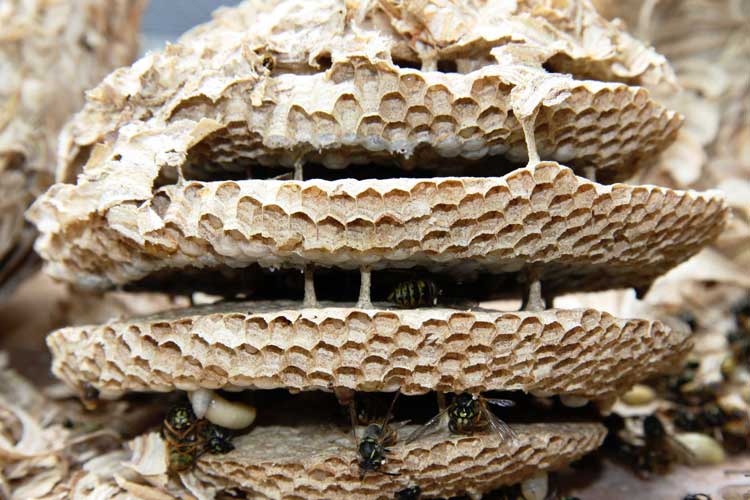
The fine papery externals of a wasp nest.Operation successful – wasp nest removed. It really is quite a beautiful structure, externally looking something like a brain made of very delicate papier-mâché. Wasp nest internals - the larvae hatchery.Breaking it open to look inside, in addition to the expected large number of dead wasps, I found a wonderful central tiered structure that was obviously the larvae hatchery. Some larvae were still alive. Perhaps it was all those yummy, fat, juicy grubs that were the main target of the animal responsible for digging up next door’s nest.

There were also a few remaining signs of very unwelcome adult wasp life so I doffed it again, sealed it plastic carrier bag and consigned it to the bin.

Technorati Tags: ,

Wasp Wars

It’s our caravanning neighbours’ turn to be away for a couple of weeks. We reciprocate looking after each others gardens while the others are away.

Yesterday morning Carol noticed a sizeable hole in one of their flower beds together with signs (i.e. scattered soil) that an animal had been digging. Closer inspection revealed the tell-tale papery remnants of a wasp nest in the cavity and frenetic activity by the real estate holders apparently attempting to affect repairs. What doesn’t mind digging up and, presumably, eating wasps, I wonder? We do have badgers in the vicinity so maybe a badger is the culprit.

I dislike wilfully killing the great majority of creatures on this planet save for food, of course; I am a confirmed carnivore, after all. However, of wasps I make an exception; those I will happily kill. So, off we went to the local garden centre in search of something with which to eradicate the irritating beasts. We returned with some Doff Wasp Nest Killer which sounded just the ticket. I applied it liberally over what remained of the nest and around any entrances I could spot. The wasps did not appear to appreciate it as the level of activity increased markedly.

My evening check on the situation revealed a satisfying amount of wasp carcases littering the nest and no visible activity whatsoever. Excellent! Curiously, magpies appear to be raiding the poisoned nest. Whilst I wouldn’t kill magpies myself, I wouldn’t mind if we ended up with a few less of them as a result.

This morning, we spotted a disturbing number of wasps coming and going just above our bedroom window under the eaves of our house. Darn, there must be a nest in the roof. We had a nest the size of a soccer ball at the opposite end of our roof some years ago and called someone out to treat that. It is still up there, smothered in white powder, largely because it is behind a lot of loft clutter, boxes and the like.

Since I now seem to have some white powder of my own, I scrambled up armed with a light and said white powder. Sure enough, there was a nest right by the eaves, this one about half the size of our previous nest.

I’ve dusted it and received a sting into the bargain. We wait with bated breath and crossed fingers to see the result.

Technorati Tags: ,

Reflections

“Unsettled” seems to be the most appropriate word to summarize our 2008 French trip.

As we approached Calais on the outbound ferry, we learned that the French were unsettled about the price of diesel/petrol (aren’t we all?) and that a few factions had begun to blockade several oil depots potentially disrupting supplies. While we were over there, lorry drivers joined in by mounting operations escargots (driving very slowly in all lanes, effectively blocking a road) on a few autoroutes (motorways). We did experience a little difficulty filling up one day but never ran into any real problem. When you’re towing potentially long distances, though, the seeds of doubt are sewn and play on your mind.

The weather was certainly unsettled, though that seems like a strange word for meteorologists to use to describe something that appears to be very settled into a pattern of rain and storms over large parts of the country. We’ve been travelling France for some 25 years now and never before had to spend entire days inside sheltering from constant rain; storms, yes, but constant rain, no. We experienced five such days on this trip. It’s certainly the worst weather we’ve ever seen in France, though, to be fair, our first 22 years were spent in July, August or September rather than May and June. Our first June trip three years ago was stunning but maybe that was the aberration.

Finally, unfortunately at the beginning of our last week, we ourselves were unsettled by a wandering band of what we suspect to be Irish navvies invading two successive campsites leading to a lot of ill-feeling on both sides. Being fully signed-up members of the brigade of live cowards, we made a tactical withdrawal to pastures new where we managed to finish on a positive note.

Cycling off some oystersGiven the few nagging doubts about fuel supplies but mainly because the weather was constantly stormy in the far south, we didn’t venture below the Dordogne river. Instead, the west coast seemed the most settled and we had three enjoyable weeks there. It has good infrastructure and is excellent for cycling. With less towing, more cycling and, consequently, less solo driving sightseeing, it was a relatively green trip which achieved of couple of my personal notional goals: cycling 100 miles per week and cycling further than we drove the car (solo, of course).

  • 1636 miles towing
  • 620 miles cycling
  • 477 miles driving

The Passage du Gois - the disappearing roadThough the weather left a lot to be desired, France didn’t fail to deliver when it comes to interesting sights. My personal favourite has to be the passage du Gois, the road that disappears under the rising tide. The almost painfully immaculate gardens at the château de Villandry come second. It would be all too easy to keep returning to our favourite haunts but new areas have to be tried to find such places. Inevitably some don’t work but some turn up gems like these. Had the weather been settled in the south, we wouldn’t have discovered them.

Western whip snakeAlso as expected, the French wildlife was fascinating with storks, coypus and western whip snakes, to name but three. Following last year’s appalling summer, there were very few butterflies (true also in England). If this year’s summer doesn’t improve, I fear the butterfly populations will be in a desperate situation.

Unsettled it may have been but, rain and navvies aside, I think we both enjoyed it. I know I did but I’m biased, I love France.

(Web album in production and to follow shortly.)

Sports Day

I had booked a 2:10 PM return ferry from Calais which is just over two hours from Neufchatel-en-Bray so we had no rush. After a leisurely packing (in the dry) we joined the exodus from the campsite, sailed along on a stiff favourable wind, and arrived at Calais ferry port at 11:45 AM.

“We’re a tad early – strong tail winds.”

“No problem, you can get on the next sailing at 1:10 PM.”

“Excellent! Thank you.”

Pole position for the Dover sprint On your marks, get set, …Not only were we on an earlier ferry but we were first to load and were in pole position ready for the sprint to the port exit and into the manic English traffic. After an excellent lunch in Langan’s Brasserie on board, Beastie (our Honda) and Billy gamely blew off the Dutch Landrover opposition alongside on the grid and took the chequered flag at the first Dover roundabout in great style. (Apologies for the quality of the second picture – it’s a mobile phone effort.)

The rain started shortly after leaving Dover and got steadily worse as we drove towards the M25. It looked like winter again. Remembering the Wimbledon final but expecting little given the current weather conditions, Carol found the appropriate radio station but we got the British F1 Grand Prix where, it seemed, Lewis Hamilton was being just as successful at taking chequered flags as we had been. It was no longer raining at Silverstone.

Then, surprisingly, on came Wimbledon which had just begun after being delayed by rain. Now it didn’t seem to be raining at Wimbledon, either. It was certainly still thrashing down not far away in Kent on the M20 where we were.

Wind-up time: long delays on the northern anticlockwise JAM25 were being signed. To avoid them, we decided to head clockwise on the southern section of the M25 passing Gatwick and Heathrow.

More signs: parts of the M40 were closed. No problem, we don’t want that.

Yet more signs: long delays northbound on the M25 immediately after the M40 exit. Oh Lord, they’ve got us both ways.

Being between a rock and a hard place, we decided to sit it out on the M25 but were pleasantly surprised to discover that the announced long delays seemed to be long gone. Relief!

More signs: long delays exiting the M25 onto the M1. Arghh! Take me back to France.

At least the rain had stopped when we got Billy back into his field for a well-earned rest.

Around Tours

(Well, through it, actually, but then the pun wouldn’t work, would it?)

The rain held off for us to finish packing in the morning (we had begun yesterday evening because rain had been forecast) and we managed to get Billy out of the campsite without any damage. The campsite at Savonnières has some "interestingly" tight corners with very unfriendly metal posts on the inside of the curve. For the unwary, they work a little bit like a can opener on the sides of caravans.

Quite a few people called in yesterday afternoon; some will be weekenders but the campsites are definitely beginning to get busier so heading home is a less painful prospect than it might be, at least until we reach Dover when reality will set in.

Our route out took us along the north bank of La Loire and into Tours. The traffic was pleasantly light and the route through Tours was relatively straightforward. When we are around the area again, it looked like a town worthy of investigation. The most notable feature to me was a fascinating French approach to bus lanes which were in the centre of the roads thus being surrounded by the main traffic. Let’s see, bus empties out travelling public, travelling public has to cross a lane of city traffic to get to the safety of the pavement/sidewalk. Brilliant! I guess they had a reason for designing it that way but I can’t seem to think of it.

The forecast rain started shortly after leaving Tours and was basically with us all the way through most of the remaining four hours of our journey to Neufchatel-en-Bray in Normandy. The skies were black from horizon to horizon. It didn’t look like summer at all but more like winter. Towards Rouen, though, things brightened up and as we were pitching up in our splendidly run campsite, the sun shone so we had a very pleasant late lunch al fresco. This part of Normandy, Pays de Bray,  is dairy country (it has an appellation contrôlée cheese) so the grass is quite lush. Although we love the feel of warmer camping in the south, it was surprisingly pleasant to be able to pad around barefoot on lush green Normandy grass.

We had considered driving into Dieppe, about 20 km distant, to seek out a proper plateau de fruits de mer (as opposed to our DIY version back in La Tremblade) for our evening meal but, after five hours driving and with booty-shopping beckoning in the local Leclerc supermarket, ultimately neither of us could face more time in the car. It was a lovely evening, we had two pleasant neighbours (also homeward bound) and relaxation won hands down.

In Leclerc, Carol found us two good-looking slices of foie de veau (calve’s liver) to grill on George. (What else are they going to do with the male calves in dairy country?) Very experimental but very successful and a quite delicious last dinner in France.

Wrong Château

We thought we’d seen the château at Azay-le-Rideau more years ago than we care to remember. I suppose I should have said more years ago than we could remember since, when we actually got to Azay-le-Rideau this morning, the château that we had seen way back then was clearly not Azay-le-Rideau. I told you there’s a château around nearly every corner, here. I wonder where that one about 20 years ago was?

Azay-le-Rideau lies on the river Indre. Like the Cher, the Indre is another tributary of the Loire. The three rivers flow together just west of Tours. Whilst the rivers themselves are reasonably attractive, it’s the châteaux scattered liberally between these three rivers that do most to make this area interesting.

Azay le Rideau We reverted to cheapskate mode, avoided the entrance fee and peered at the chateau through the gate. It looked as though we’d just have got a lot of converging verticals anyway. It looked as there were no interesting outside photographic subjects to play with – no more fancy gardens as with Villandry.

McBunny and McBeans from Villandry We returned for an experimental lunch. Yesterday, having finally found a supermarket in a suburb of Tours after a painstaking search, we couldn’t resist buying some burger patties made from 100% viande de lapin (rabbit meat). Here was a potentially untold source of riches that McDonalds has yet to exploit – McBunny burger! How could we resist? We’d decided to accompany it with our aristocratic broad beans from the splendid gardens of the château de Villandry. McBunny and McBeans – what a feast! Presumably the bread is rabbit shaped because it’s made from doe. 🙂

We had intended to visit Amboise in the afternoon and try to find the Leonardo da Vinci museum there. Ultimately, we couldn’t face the journey and preferred another more relaxing pedal along the Loire cycle track. Our notional target was a 16th century water mill. We made it, of course, after all our intense training but it was relatively dull, as was the weather, so we just pedalled a little further before returning in some gentle rain.

Tomorrow, we head north to Neufchâtel-en-Bray in Normandy for our last night in La Belle France.

Villandry

We came here to Savonnières mainly to see the supposedly spectacular formal gardens at the château de Villandry. We set off in the morning to cycle the two or three miles to Villandry hoping to beat the crowds that might arrive for the afternoon. Our 600 cycling miles scrolled passed on way – notional target of 100 miles a week achieved, yeah! Naturally, there were already a lot of visitors but it was surprisingly uncrowded in the gardens themselves. Maybe they were all inside the chateau itself. In our normal cheapskate fashion, we went for the gardens-only ticket (€6.00 each- very reasonable).

Villandry ChateauI’m not the world’s greatest fan of gardens, especially those which are extremely formal. I always think Mother Nature tends to do a much more enjoyable job. However, the extreme precision of the garden layouts at the chateau de Villandry are, I must confess, very impressive. It isn’t the kind of garden that you’d fire up the charcoal in then relax by cracking a few beers while it burns up, but it is undeniably very enjoyable to look at. It makes for a very interesting photographic subject. Don’t touch anything, though, it looks as though it just may break.

An overview of the most formal parts of VillandryVillandry, the last of the great châteaux built near La Loire, was completed in about 1536. It is still privately owned by the descendents of one Dr Joachim Carvallo who bought it in 1906 to save it from destruction. He recreated the very formal gardens that exist now following the styles used by the original plantings. There is an ornamental garden depicting various types of love (so says the guide), a kitchen garden (which is also very ornamental even though vegetables are involved – so say I), a water garden with fish the size of whales, a medicinal herb garden and a maze. The strongest visual impact comes from the geometric designs of both the ornamental and kitchen gardens.

Now that's what I call a water featureI know statistics can rapidly get boring but some just have to be repeated to give an idea of the scale of the effort involved in the upkeep of this place. Surrounding the garden are 1,260 lime trees which take four gardeners four months just to prune. There are 52 km of box hedging. 250,000 flower and vegetable plants are raised and planted out every year. All the weeding must be manual because, apparently, the box hedges which surround every plot have very delicate roots.

The vegetables are harvested and many are left out for the public to help themselves. There is no price, they just ask for a voluntary contribution for the gardeners. Planting is kept very authentic; there are no potatoes, for example, since, in 1536 no one had invented Americans or potatoes. 🙂 (With humble apologies to native Americans.) We grabbed a Euro’s worth of broad beans.

It was great – I enjoyed it much more than I thought I would.

To the Cher, mon Cher

Terrific, we awoke to rain which soon got quite heavy. I detest packing up in the rain, especially the awning which, owing the late evening disturbances, was still up and saturated. However, pack we did, wet we got and the road we hit (all very Yoda).

We’d really wanted to stay where we were until the last minute but, discretion being the better part of valour when it comes to possible tussles with Irish navvies, we decided to visit a new part of La Loire where Carol wanted to visit some supposedly impressive gardens at the château de Villandry. We headed for Savonnières close to the confluence of le Cher and La Loire.

It rained for most of our four hour journey. Having packed in the rain, I was fearing setting up in yet more rain but, fortunately, it ceased and we set up in the dry.

SavonnieresA Cher 'la toue' boat Once we were settled, we went out to investigate the local area. There is only the Loire à velo cycle track between us and the river Cher. Wandering up the track towards Savonnières, we discovered several old wooden boats. Close by, an exhibit has a partially built boat showing several of the construction stages. The boats are "faithful reconstructions" of medieval craft used for various tasks (e.g. transport, fishing) and particular in design to the river Cher.

We didn’t want to finish our trip feeling unsettled by itinerants. Let’s hope we’ll feel more comfortable here.

Top
Follow

Get every new post delivered to your Inbox

Join other followers: